Every "Golden Route" guide agrees on the shape: Tokyo, then west to Kyoto and Osaka. What almost none of them answer are the three questions that come up once you actually sit down to book it: Does the Japan Rail Pass pay for itself? What's worth adding — Hakone, Nara, Hiroshima, Kanazawa — and what doesn't fit the route at all? And is there a better way to move a suitcase between four cities than dragging it onto every train?
This guide answers all three with real fares and reporting, including two things missing from the usual English-language roundups: a current-year shift in where Japanese travelers themselves are choosing to go, and the courier trick that moves your luggage between cities for you.
The Route, Mapped: One Direction, Not a Loop
The version of the Golden Route this guide is built around is the one-way kind: fly into Tokyo, travel west by train, and fly home from Osaka's Kansai International Airport (KIX) instead of doubling back. It's the same open-jaw booking strategy covered in our guide to flying into Tokyo and out of Osaka, and it removes a full day of backtracking that a round-trip itinerary otherwise builds in.
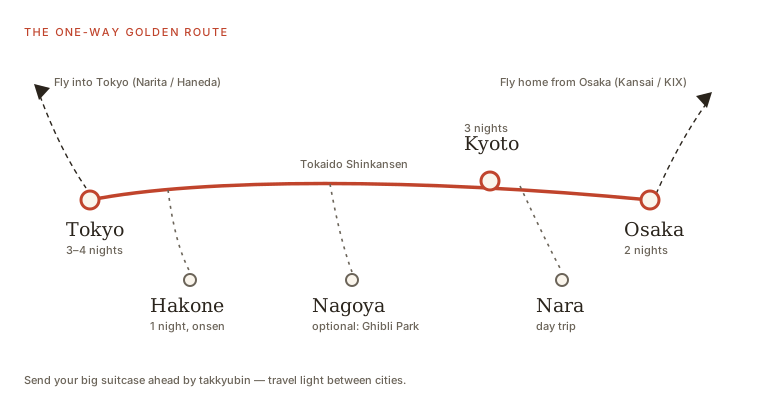 The one-way Golden Route: fly into Tokyo, ride west, fly home from Osaka (KIX).
Here's what each leg actually costs and takes, as of July 2026:
Standard adult fares and travel times for the core Golden Route legs, plus the common Nara detour.
| Fare | Time | Covered by Japan Rail Pass? | |
|---|---|---|---|
| Narita Express, Tokyo Station-Narita Airport | 3,140 yen (~$21) | ~1h | Yes |
| Shinjuku-Hakone-Yumoto (Romancecar) | 2,470 yen (~$16) | ~1h25m | No (private railway) |
| Nozomi shinkansen, Tokyo-Kyoto (reserved) | 14,370 yen (~$95) | 2h08m-2h16m | No (Nozomi needs a separate ticket) |
| Kyoto-Nara, JR Miyakoji Rapid | 720 yen (~$5) | ~45-47m | Yes |
| Kyoto-Nara, Kintetsu Limited Express | 1,280 yen (~$8) | ~35m | No (private railway) |
| Haruka Limited Express, Kansai Airport-Shin-Osaka | 3,120 yen (~$21) | - | Yes |
First, the fastest way to Kyoto (Nozomi) and the two most common ways into Hakone and Nara (Odakyu and Kintetsu, both private railways) fall outside standard Japan Rail Pass coverage. Second, there's almost always a JR alternative that's covered, just slower — the Miyakoji Rapid to Nara being the clearest example.
Buying as you go is easy: station machines sell same-day shinkansen tickets, and if you'd rather lock in seats before you fly, Klook sells Tokyo-Kyoto shinkansen tickets with QR-code boarding — its pricing moves with dates and train type, so compare it against the station fare above before you buy.
Does the Japan Rail Pass Actually Pay Off?
You'll see confident claims in plenty of English-language guides that a 7-day Japan Rail Pass "pays for itself several times over" on a Tokyo-Kyoto-Osaka trip. Here's what the numbers actually say for the one-way route this guide is built around.
A standard 7-day Japan Rail Pass costs 50,000 yen (about $329) as of July 2026 — already a steep jump from its 29,650-yen price before an approximately 70% increase took effect in October 2023. Add up only the segments of a one-way Tokyo-in, Osaka-out Golden Route that a standard pass actually covers:
What a Japan Rail Pass actually covers on a one-way Golden Route, added up.
| Yen | USD (approx.) | |
|---|---|---|
| Narita Express, Tokyo Station-Narita Airport | 3,140 | $21 |
| Shinkansen, Tokyo-Kyoto (Hikari, pass-eligible fare) | 14,370 | $95 |
| Nara day trip round-trip, JR Nara Line | 1,440 | $9 |
| Haruka Limited Express, Shin-Osaka or Kyoto-Kansai Airport | 3,120-3,640 | $21-$24 |
| Total covered | ~22,000-23,000 | ~$145-$150 |
That's under half of what a 50,000-yen pass costs. Hakone's Romancecar and Kintetsu's routes into Nara — two of the most common detours on this exact route — don't count toward that total at all, since both run on private railways outside pass coverage. Stretch the trip to include Hiroshima on a 14-day pass: add the Kyoto-Hiroshima and Hiroshima-Shin-Osaka Nozomi legs and the covered total comes to roughly 45,000 yen (about $296) — still short of the 14-day pass's 80,000-yen (about $526) price.
A Japan Rail Pass earns its price back through repetition — riding the same long-distance route more than once, or stacking several long rides together. A one-way route does the opposite by design: every extra day tends to add a new one-way segment rather than a repeat ride, so the math doesn't get closer to breaking even the longer the trip runs. If you're planning a loop instead — say, Tokyo-Kyoto-Osaka-Tokyo — the math changes substantially, since a return shinkansen fare alone can approach 28,000 yen and closes most of the gap with a 7-day pass.
One more timing note: JR East announced in April 2026 that overseas-agency pricing on the Japan Rail Pass rises again for purchases made from October 1, 2026 onward (the standard 7-day pass moving to 53,000 yen), while the official web reservation service is, for now, holding its current pricing with no announced end date. If you're booking a trip for later this year, check the official reservation site's current price before you commit.
None of this means the pass is a bad product — it means pricing it against your actual route before assuming it's the default smart purchase.
What to Add: Hakone, Nara, Hiroshima, or Kanazawa?
Once the core route is set, the real planning question is which detour earns its place. Each of the four common candidates has a genuinely different character.
Hakone is the classic choice for a reason: hot springs, a chance at a Mt. Fuji view (weather permitting), and transport that's easy to bundle through a Hakone Free Pass covering the area's mountain railway, ropeway, and pirate ship cruise (7,100 to 7,500 yen from Shinjuku, or 6,000 to 6,400 yen from Odawara, adult fares). It fits naturally as an overnight stop between Tokyo and Kyoto, and it's your best chance on this route to book a proper onsen ryokan — worth doing thoughtfully, since Japanese travelers don't book ryokan the way most first-time visitors assume.
Nara is normally treated as a straightforward day trip — deer, the Great Buddha at Todai-ji, an easy add from Kyoto or Osaka — and that's still true. But since 2025, Japanese outlets have reported a real shift: Japanese travelers themselves increasingly prefer Nara over Kyoto. TV Asahi's ANN reported Japanese tourists describing Nara as the more relaxing option, with foot traffic at its major temples and shrines outnumbering Kyoto's during this year's Golden Week. Bloomberg's Japanese-language edition reported the same pattern independently, noting declining Japanese visitor numbers even at Kinkaku-ji and Kiyomizu-dera, with Nara picking up the difference.
One caveat: a Kansai TV feature on the same trend noted that Nara empties out fairly early, around 7 p.m., since it lacks Kyoto's density of evening restaurants and nightlife — it rewards an early start more than a late one.
Hiroshima and Miyajima sit further out — 1 hour 20 minutes to just under 2 hours past Kyoto or Osaka by shinkansen — and carry a different kind of weight than the other three. The Peace Memorial Park and Atomic Bomb Dome, alongside Miyajima's floating torii gate, make this less a scenic detour and more a piece of modern Japanese history. It's the natural anchor for a 14-day trip rather than a 10-day one, since the distance alone eats most of a day each way.
Kanazawa has been picking up attention as a "second Kyoto" — Kenrokuen Garden, the Higashi Chaya geisha district, strong local craft and food culture, and noticeably lighter crowds than Kyoto's. The catch: 2 hours 25 minutes and 14,380 yen from Tokyo on the Hokuriku Shinkansen, or a transfer-heavy 1 hour 50 minutes to 2 hours 20 minutes and about 7,720 yen from Kyoto via a Thunderbird-to-shinkansen connection at Tsuruga. It's worthwhile with 14 or more days to work with, but doesn't fold neatly into a standard 10-day trip.
Nikko shows up in some "Golden Route" round-ups, but it's really a Tokyo-area day trip — about two hours from Asakusa by Tobu limited express — sitting north while the rest of this route heads west. If you're drawn to it, treat it as an extra day tacked onto your Tokyo stay, not a stop on the way to Kyoto.
The Right Number of Days: 7, 10, or 14?
English-language itinerary guides for this route show a fairly consistent pattern, and it holds up against what actually fits geographically.
A realistic day-by-day allocation for the one-way Golden Route, by trip length.
| 7 days | 10 days | 14 days | |
|---|---|---|---|
| Tokyo | 3 nights | 3 nights | 3-4 nights |
| Hakone | Skipped | 1-2 nights | 1-2 nights |
| Kyoto | 2 nights | 2-3 nights | 3 nights |
| Nara | Day trip | Day trip | Day trip |
| Osaka | 1-2 nights | 1-2 nights | 1-2 nights |
| Extension | None | None | Hiroshima/Miyajima, 1-2 nights |
Seven days is workable, but tight — Nomadic Matt's own 7-day guide admits the pace is rushed and recommends ten if you can manage it. That tracks: a seven-day version of this route means skipping Hakone entirely just to fit Tokyo, Kyoto, Nara, and Osaka in.
Ten days is the realistic target for most US visitors, matching the roughly 10-to-12-night trip length typical for US travelers to Japan. It's long enough to add Hakone without squeezing Kyoto, and still ends cleanly in Osaka for a Kansai Airport departure.
Fourteen days is where Hiroshima and Miyajima (or Kanazawa, if lighter crowds matter more to you than historical weight) earn a real place on the itinerary, without cutting time from Tokyo or Kyoto to make room.
The Suitcase Trick No English Guide Mentions
Here's a habit that's practically universal among Japanese domestic travelers and almost entirely missing from English-language planning guides: you don't have to carry your suitcase between cities at all.
Yamato Transport, Japan's largest courier network, runs a takkyubin delivery service that moves a suitcase from one hotel directly to the next, no need to lug it through a station transfer. A next-day delivery between the Kanto region (Tokyo, Hakone) and the Kansai region (Kyoto, Nara, Osaka) costs about 2,930 yen (roughly $19) for a mid-size bag or 3,320 yen (roughly $22) for a large one, paid in cash at any Yamato counter or participating convenience store.
If next-day isn't fast enough — say, you want your bag waiting the moment you land — same-day delivery is available too. Sending a suitcase from Haneda Airport to a hotel within Tokyo's 23 wards runs about 5,180 yen (roughly $34) per piece, and sending one from Yamato's counter near Kyoto Station to a hotel within Kyoto city runs about 2,870 yen (roughly $19) per piece. Yamato also offers a round-trip courier option for hotels, ryokan, and airports, though pricing for that service is quoted per specific route rather than published as a flat rate.
In practice: hand your suitcase to the front desk the evening before you change cities, keep an overnight bag with you, and travel the next day with just what fits under a train seat. On a route that moves through four or five cities in one direction, that's the difference between a genuinely relaxed shinkansen ride and wrestling a 23-kilogram case through a station transfer with a tight connection.
Putting It Together
The Golden Route lives up to its reputation — plan it with real numbers instead of secondhand assumptions. Check the Japan Rail Pass against your actual one-way route rather than trusting a flat "it pays off" claim. Pick your extra stop based on what you actually want (Hakone for the classic detour, Nara for the current-year shift away from Kyoto's crowds, Hiroshima for weight, Kanazawa if you have the days to spare). And once your route is set, pair it with an open-jaw flight into Tokyo and out of Osaka so you're not burning your last full day in Japan on a train back to where you started.