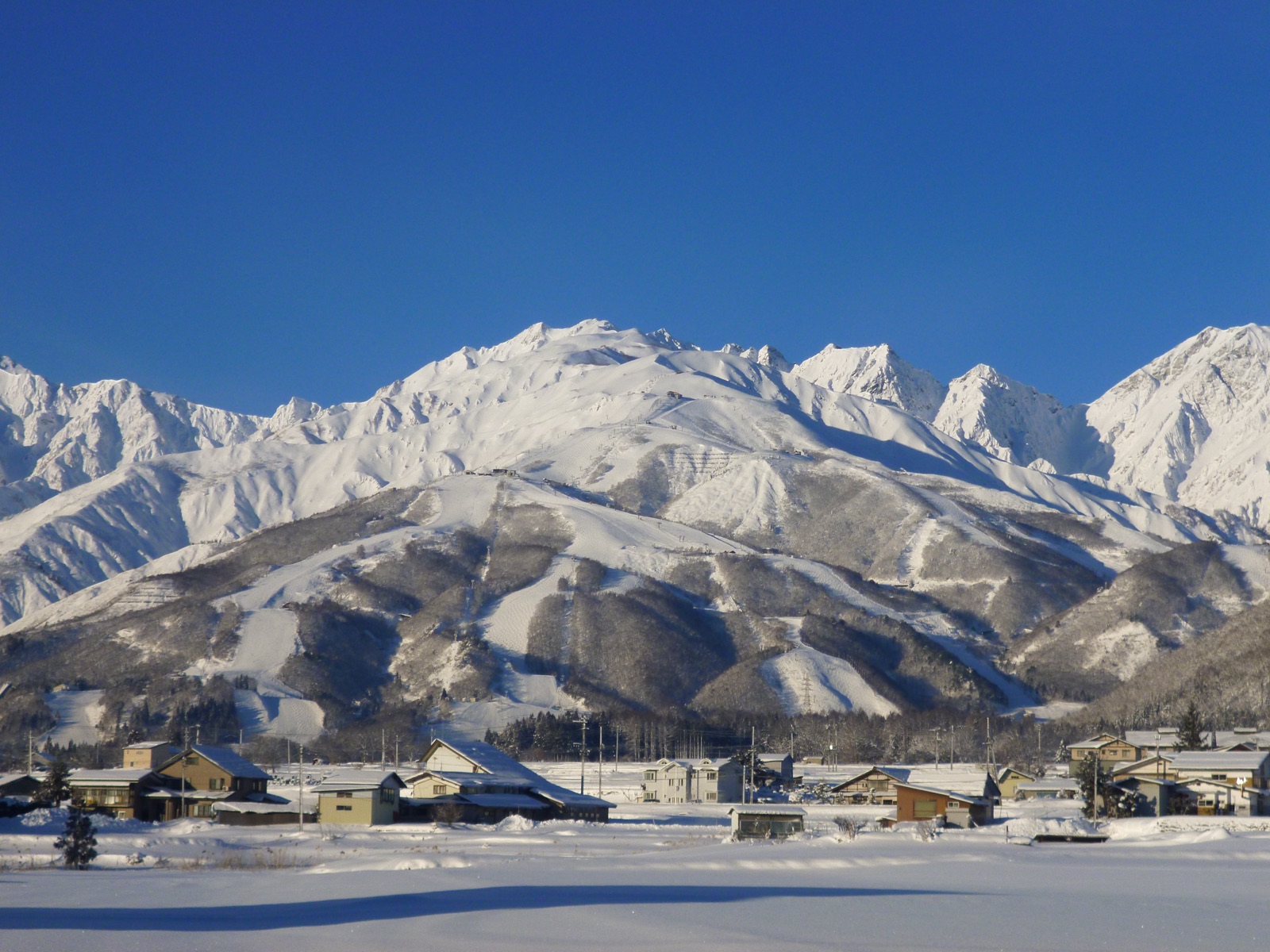
Hakuba isn't a ski resort — it's ten of them, spread across two villages and a city, stitched together by one lift pass and a network of shuttle buses. That's good news if your family wants variety; less good news if you book a hotel first and only work out the logistics once you land.
I spent two months living and working in the Happo area of Hakuba, and the question I got asked most by visiting families wasn't "is Hakuba good?" — it obviously is — but "which bit of it should we actually stay in?" That's the question this article answers, and the honest answer has almost nothing to do with hotel star ratings and everything to do with how your family plans to spend the week.
Is Hakuba one ski resort, or ten of them?
Ten, technically. Hakuba Valley is the umbrella name for ten ski areas across Hakuba village, neighbouring Otari, and the city of Omachi: Happo-one, Hakuba47, Goryu, Hakuba Iwatake, Tsugaike Kogen, Hakuba Cortina, Hakuba Norikura Onsen, Hakuba Sanosaka, Jiigatake and Kashimayari. Most visitors only ski four or five of them; locals buy the all-mountain pass and move between resorts by shuttle bus rather than commit to one gate for the whole holiday.
Your base decides which resorts are a short walk away and which ones mean a bus ride with tired kids in ski boots — decide that before you fall for a particular hotel's photos.
Which base fits your family — Happo, Echo Land, or Misorano?
Three names come up constantly, and they suit different families for different reasons.
Happo is the valley's gateway. The highway bus terminal is here, making it the easiest place to arrive with jet-lagged kids and too much luggage, and it's also home to Happo no Yu, a large day-onsen fed by a naturally hydrogen-rich, highly alkaline spring that's genuinely uncommon in Japan. Happo has been the most tourist-facing part of the valley for decades, and it shows: more places to eat, more places to rent gear, and a ski school that has taught in English since 2000.
Echo Land sits between the base areas of Happo-one and Hakuba47, and its single main street is dense with cafes, izakaya, bars and souvenir shops — the best concentration of places to eat and drink in the valley after dark. The catch: it isn't on the snow, so getting from your hotel to the lifts each morning means a car, a hotel shuttle, or the village shuttle bus.
Misorano, just along from Echo Land, runs the same idea at a slightly smaller scale — a dining strip that fills up on weekends and over school holidays, popular with visitors and Hakuba's own ski staff alike.
None of the three is the wrong choice. They just answer different questions: step off your hotel doorstep onto a bus already heading to the slopes, or into a strip of good restaurants and sort the ski logistics separately?
The honest answer to "which base" depends less on the resort itself and more on what your family wants to do once the lifts close.
| Mixed-ability or advanced family | First snow trip with young kids | Travelling without a rental car | Bigger group chasing food and atmosphere | |
|---|---|---|---|---|
| Best base | Happo | Tsugaike Kogen or Goryu | Happo | Echo Land or Misorano |
| Why | Long, varied terrain plus easy access to the rest of the valley | Gentle, wide slopes and an actual kids' park to fall back on | It's the transport hub — no transfer to arrange | The valley's densest run of cafes, izakaya and bars |
| Getting to the lifts | On the doorstep at Happo-one | Short shuttle or drive | On foot from the bus terminal | Car, hotel shuttle or village shuttle bus |
| After skiing | Happo no Yu onsen, then a short hop to Echo Land for dinner | Unhurried and family-friendly | Whatever your hotel's shuttle timetable allows | Everything within walking distance |
Which slopes suit your kids' ages and levels?
The valley's size stops being a headache here — the ten resorts have genuinely distinct personalities.
Tsugaike Kogen gets the heaviest snowfall in the valley, and its main slope is a wide 1,200 metres — gentle enough to stay open into Golden Week in early May. It has a 70-by-70-metre kids' park, and it's the resort locals point beginner-heavy families toward first.
Goryu, paired with Hakuba47 on a shared lift ticket, splits the difference nicely. Goryu leans toward beginner and family-friendly courses, with its own Usagidaira Kids Park, while Hakuba47 next door is built around a terrain park and tree runs for whoever in your group wants to push harder.
Hakuba Sanosaka is the quiet option — about 80% of its runs are beginner or intermediate, and locals treat it as something of an open secret for families who'd rather ski at their own pace than deal with crowds.
Happo-one is the opposite kind of resort: 220 hectares, 13 courses, a 1,071-metre vertical drop, an 8-kilometre longest run, and host of the 1998 Nagano Winter Olympics. It's the valley's "serious skiing" address, popular with confident intermediate and advanced skiers.
Hakuba Cortina, at the northern end of the valley, is where locals send serious powder hunters, thanks to tree runs cut through natural terrain — though it has its own kids' park too, for a mixed group.
Hakuba Iwatake is the odd one out, in a good way. Its main draw these days is the Mountain Harbor, a scenic terrace at the summit that's pulled in visitors who have never clipped into a pair of skis. If you've got a non-skiing parent, or older kids who'd rather take photos than ski, Iwatake gives them somewhere to go besides the hotel room. It also runs private ski lessons in English.
- AvoidChoosing Echo Land for the food scene without a transfer plan
The restaurants are genuinely worth it, but the strip isn't on the snow. Families who don't sort out a shuttle or drive first thing tend to lose the best part of the morning working it out on the fly.
- AvoidJudging Happo-one's runs by the trail map alone
Local skiers describe Happo's grading as tougher than the rest of the valley. If your kids are true beginners, don't assume a "beginner" run here will feel the same as one at Tsugaike or Goryu.
Do you need a rental car in Hakuba?
Not necessarily — and for most families it's simpler not to. Happo works well without one, since the highway bus already drops you at the valley's transport hub. The trade-off is anywhere that isn't slope-side, like Echo Land, where you'll need a car, a hotel shuttle, or the village shuttle bus to reach the lifts each day.
If you're not driving, confirm your hotel's shuttle schedule before you arrive — not after, with luggage and jet-lagged kids in tow.
How do you get from Tokyo to Hakuba with kids and luggage?
There are three realistic options, and none is a straightforward one-seat ride — decide in advance rather than working it out at Tokyo Station with everyone in tow.
- 01Shinkansen plus express bus (fastest)
Take the Hokuriku Shinkansen from Tokyo Station to Nagano — a reserved seat is about ¥8,340 (about AU$85) and takes 80–100 minutes — then change to an express bus for Hakuba, about ¥2,000–2,200 (about AU$20–23), another 60–90 minutes. All up, budget around 3 to 3.5 hours and roughly ¥10,000 per adult.
- 02Limited express Azusa (no change of train)
The Azusa runs directly from Shinjuku to Hakuba's main stations with no transfer at all, which matters with small kids and heavy bags. It's slower — about 4 hours — and costs around ¥8,050 (about AU$83).
- 03Highway bus (cheapest, longest)
Daytime and overnight buses run from Basta Shinjuku's south exit to Happo, from around ¥5,200 (about AU$54) for a trip of just under 7 hours. There are more departures through winter, but seats sell out and prices climb over the busiest weeks, so book earlier than feels necessary.
Whichever route you take, most of the on-the-ground logistics — which bus actually stops near your hotel, what time the last shuttle runs, whether a restaurant is even open that night — live on Japanese-language timetables and signage. It's worth sorting out a working data plan before you fly so you can check these things in real time rather than guess; my rundown on picking an eSIM for Japan covers how Australian travellers usually set this up.
What does a family ski day actually cost?
Lift tickets in Hakuba aren't cheap by Japanese standards. Across Japan's 64 major resorts, the average adult day pass was ¥7,327 in the 2025–26 season (about AU$75) — up 8% on the year before, and roughly ¥2,000 higher than four years ago. Only four resorts nationwide charge over ¥10,000 for a single day, and Hakuba Valley's all-mountain common pass is one of them.
Prices below are for the 2025–26 season, with a rough Australian-dollar conversion (using about ¥95–100 to the dollar, checked July 2026).
| Hakuba Valley common pass | Happo-one (peak) | Goryu & Hakuba47 | Tsugaike Kogen | |
|---|---|---|---|---|
| Adult, 1 day | ¥10,400 (~AU$105) | ¥8,700 (~AU$90) | ¥9,500 (~AU$95) | ¥8,200 (~AU$85) |
| Child (6–17) | — | ¥4,350 (~AU$45) | — | — |
Happo-one is also the one resort in the valley with published off-peak pricing: an adult day pass drops to ¥5,000 in early December (1–19 December) and to ¥5,500 across the spring season (16 March to 6 May) — worth knowing if your dates are flexible.
Where do you eat, warm up and relax after skiing?
For something warm and simple, three ramen shops keep coming up in local recommendations: Ra-men Tottsuan, run by a chef who trained for a decade at a well-known shop in Osaka and serves a pork-bone broth; Takahashiya, known for a dashi-free Hakuba tantanmen; and Onsen Ramen Happobijin, which makes its own noodles with actual onsen water from the local spring.
And one treat I can vouch for personally: Momochan Crepe, the bright pink stand right by the Happo-one gondola base, famous locally for crepes more than twice the usual size. My order is the tiramisu crepe.
During my two months in Happo I ate there several times a week, and by the time I moved back to Tokyo I was four kilograms heavier. I still don't regret it. Kids love the place; you have been warned.
And if you only do one non-skiing thing as a family, make it Happo no Yu — the onsen mentioned earlier, and worth building an afternoon around on its own.
If your trip spans New Year, locals see it in at the shrine — I once joined the walk to Hosono Suwa Shrine in Happo, a small village shrine near the slopes with a sacred cedar said to be over a thousand years old, where people line up in the snow at midnight for the year's first prayers. It costs nothing, needs no booking, and will likely be the most Japanese hour of your entire ski trip.
Is Hakuba still the quiet, affordable village people talk about?
Less than it used to be. Hakuba's own 2024 tourism figures show Australian visitors peaking in January, with 45,680 visitor-nights that month alone — the highest of any month of the year, lining up with Australian school holidays in December and January.
Across the whole valley, the 2024–25 season drew roughly 890,000 skier visits, the highest in 20 years, and 46% of them were from overseas. The village overall passed 2.7 million visitors in 2024 and reached around 2.9 million in 2025 — about 20% above pre-pandemic 2019 levels.
Land prices have moved with the tourism numbers: commercial land in Hakuba village rose sharply in a single year in one 2024 government survey, among the steepest increases in the country, and land near the bus terminal has more than tripled since 2018.
What hasn't changed is how the village positions itself. Hakuba's local businesses have deliberately steered away from the foreign-capital-driven redevelopment model associated with Niseko, describing their own approach as locally led rather than "chasing Niseko." Accommodation still makes up about 30% of the village's economy, and most of it is family-run minshuku — Hakuba is sometimes called the birthplace of the minshuku in Japan. If you're weighing up the two valleys against each other, rather than just deciding where to stay within Hakuba, it's worth reading how Niseko and Hakuba actually compare for families before you book anything.
None of this changes the basic advice: work out what your family actually wants from the week — easy transport, gentle slopes, a proper kids' park, or somewhere good to eat after dark — and pick the base that matches it, rather than the hotel with the best photos. Hakuba rewards that kind of planning more than most ski destinations, precisely because it's ten resorts quietly pretending to be one.